
Why Quantize Gravity?
On the Limits of Semiclassical Theory

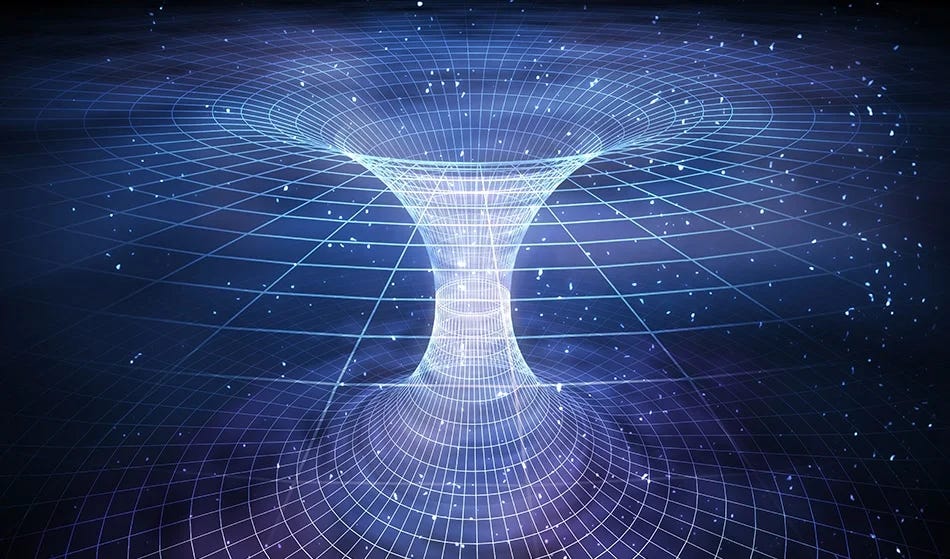
(Author’s Note: the following is a distillation and extension of Prof. Frederic Schuller’s sharp insights in the timestamped portion of this exceptionally illuminating and wide-ranging discussion with Curt Jaimungal)
General Relativity (GR) and Quantum Field Theory (QFT) provide “unreasonably effective” descriptions of reality on cosmic and microscopic scales, respectively. Despite their individual successes, however, the two are built upon mutually exclusive mathematical and philosophical foundations. This foundational schism becomes an outright contradiction at the point where the two theories meet: the domain of quantum gravity.
Mathematically, this inconsistency is made concretely manifest in the Einstein Field Equation:
which equates—or rather attempts to equate—two fundamentally different kinds of mathematical objects.
The left-hand side, the Einstein tensor Gμν , is a deterministic description of spacetime curvature on a smooth manifold: a classical tensor field. But the right-hand side, the stress-energy tensor Tμν , is primarily sourced from matter fields. If matter fields behaved purely classically and deterministically, this would not be a problem; as is well known, however, matter is irreducibly quantum, and so by mathematical necessity any theory of matter fields must be precisely a quantum field theory. However, in any quantum field theory, the right-hand side must be not Tμν but T̂μν : that is, not a classical tensor (“c-number”), but a quantum operator (“q-number”). Naïvely equating Gμν and T̂μν is thus, as it stands, a profound mathematical and conceptual error. Simply put: a smooth, deterministic geometry cannot equal an irreducibly stochastic operator-valued distribution, any more than a real number could generically equal a matrix.
The most immediate and seemingly obvious “fix” for the problem outlined above is to replace the actual underlying physical quantum operator on the right-hand side with its classical, deterministic, statistically-averaged expectation value:
“Semiclassical” approaches to quantum gravity thus maintain mathematical consistency by ensuring that both sides of the equation are well-behaved classical tensors. This allows for stunning results, such as the calculation of the thermal spectrum of black holes; however, it also leads to severe mathematical and physical problems, such as the “Black Hole Information Loss Paradox” and the “Trans-Planckian Problem.”
Why?
The core trade-off for semiclassical physical theory is that its internal coherence comes at the cost of throwing away essential physics. Taking the expectation value of T̂μν is, in the most literal possible sense, performing a quantum measurement on the stress-energy operator. “On large scales,” “in the infinite limit,” etc., this is not a problem: “it all averages out.” But while ⟨T̂μν⟩ provides a smooth average, it also discards the variance and higher moments of the physical wavefunction (/matter-field modes). By construction, in other words, semiclassical approximation is only valid when quantum fluctuations are small relative to the mean energy.
All quantum correlation, entanglement, and fluctuation information—the most crucially important features of the quantum gravity regime—are thus lost in the transformation from quantum operator(-valued distribution) to classical tensor field. This is precisely why semiclassical approaches fail where they are most needed: on the smallest scales, in the regime of quantum gravity, where vacuum fluctuations do not necessarily “average out,” but on the contrary may make highly nontrivial contributions to the local energy landscape.1
More broadly, moreover, a profound structural paradox lies at the heart of the semiclassical approach to quantum gravity. The standard procedure used to define quantum matter in the Standard Model of Particle Physics is predicated on a mathematical foundation that the very notion of “quantizing gravity” renders entirely inapplicable.
Following Eugene Wigner, a particle is standardly defined as an irreducible, projective, unitary representation of the universal covering group of some spacetime symmetry group. Classically, then, “a particle” just is an irreducible representation of [the universal covering group of] the Poincaré group on Minkowski space. The Standard Model of Particle Physics adds to this description some characterization under the internal gauge group SU(3) x SU(2) x U(1)[Y], but retains the same basic structure.
Crucially, however, this construction—that is, the entire framework of the Standard Model—presupposes a flat, non-dynamical spacetime. One must first have a static background with a well-defined symmetry group (e.g., Minkowski spacetime with the Poincaré group) in order to construct the Hilbert spaces and measurement operators that describe the quantum matter living on that space. Generically, in curved spacetime, there is no way to globally distinguish between positive- and negative-frequency field modes, which is to say, between positive and negative energy eigenvalues; global translation invariance is broken. Thus the stability of the vacuum, and the coherence of the physical theory, depends entirely upon the choice of inertial reference frame: in particular, only static frames are suitable. Otherwise, in the absence of some invariant “observer at infinity” to impose positive-definiteness on the total state space, “particle” becomes ill-defined precisely because there is no longer any such thing as a well-defined local spacetime symmetry group; the mathematical structure required by Wigner’s classification has been lost.
Functionally, semiclassical approaches to quantum gravity attempt to take a classical background spacetime and promote its defining feature, the metric tensor gμν , to the status of a quantum operator. However, one cannot logically define “particles” as representations of a fixed symmetry group while simultaneously dynamizing the background structure that defines those symmetries; it would be like trying to paint on running water.
We have become accustomed to thinking of physical interactions—the “strong,” “weak,” and “electromagnetic” “forces”—as being mediated by quantum particles (“gauge bosons”). We have also become accustomed to thinking of gravity as “a force.” It is only natural to suppose that, if gravity is an interaction, it must have its own corresponding gauge boson: the graviton. And to get the graviton, one must quantize the gravitational field.
But what if this very way of looking at things is itself the source of the problem? What if these foundational paradoxes are not technical difficulties to be overcome, but instead a sign that we have been asking the wrong question entirely? The truly fruitful question may not be “How do we quantize gravity?”, but rather: “How do we avoid needing to posit the existence of gravitons?”.
I request that you, Curt, do a deep dive into explaining the imaginary unit.
🙏